Marx and Mysticism
Part I

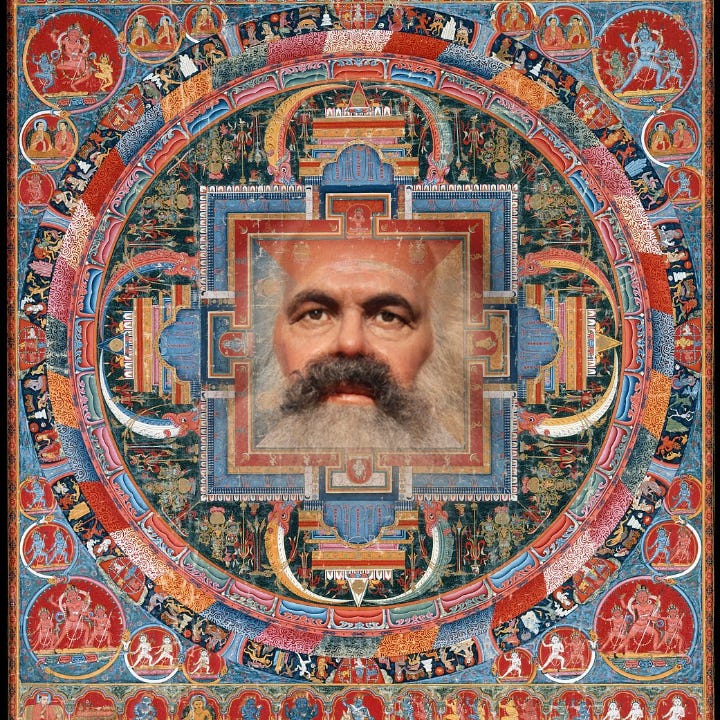
First things first. Marx’s analysis of capitalism and its inherent pathologies was both highly cogent and highly useful. Capitalism—whatever one may believe its benefits have been to whatever class of people for whatever period of time—is the engine driving our collective ecocide and the failure of liberal democracies worldwide to achieve the level of social justice which they once promised. So Marxian analysis of sociopolitical economies is indispensable for understanding the current and potential future state of things.
That said, Marxism qua Marxism has its natural limits. The man Marx was a human creature of mid-19th century Mitteleuropa and, as such, possessed neither omniscience nor the benefit of all that we’ve learned and experienced since he wrote his masterwork. Marxist thought has certainly evolved since his passing, but this simply means that a large number of thinkers have built upon Marxian analysis and, in doing so, appropriated Marx to themselves.
To paraphrase Nietzsche, there has only been one Marxist and he died in London.
My intent here is thus not to critique Marx or Marxism per se. It is instead to make two suggestions regarding anticapitalism in the 21st century. The first is to suggest that we call anticapitalism “anticapitalism” and not something else. Excessive referentiality to Marx semantically promotes exactly what every good Marxist should abhor: the Great Man theory of history. Marx was Marx, and he served an important role in the history of human thought. So did Kant, Luxemburg, and Fanon.
But to build the theoretical underpinnings necessary to practice and promote the much-needed revolution in human affairs, we don’t need to personally identify as Hegelian Leninist-Tureians. We can instead simply say what we mean and mean what we say.
To again echo Nietzsche, calling oneself a “Marxist” in 2022 is a bit like calling oneself a “Christian.” It is a claim that becomes ever emptier as it is repeated by more claimants. “Christian” has, in fact, become a rather empty identifier—or at least one that says more about the interior identities that its claimants imagine for themselves than any claimant’s actual beliefs. Invocations of both Christ and Marx, respectively, also tend to promote arguments over orthodoxies rather than evolving epistemologies. Those of us seeking to relegate capitalism to history’s Facebook Memories might therefore do well to heed the fate of the teacher Jesus.
My second suggestion is a more complex one. It entails the exercise of extreme caution in mistaking dialectical materialism (an important and useful tool in the analysis of how economic relations impact socio-political relations) for reductive materialism, which:
Catalyzes a host of bad ideas, including anti-indigenous white/western supremacism and technocratic fetishization of something mistakenly called “science”
Inexorably suckers anticapitalists into debating individualists on their own quantitative/materialistic turf, rather than rightly establishing the terms of the discussion as collective and experiential
Is a demonstrably false position given what we’ve learned over the past 150 years about physics, software, and consciousness.
More specifically, it’s my assertion that something I call “apophatic immaterialism” is a much more sensible, productive, and antiracist position for 21st century anticapitalists.
But regardless of whether you buy into my rather specifically named alternative, I hope the arguments that follow will convince you to use appropriate caution in tying yourself to a reductive platform that is too western, too white, and too weak to serve our shared purpose—which is nothing less than a revolution that will save the world from its present self.
More to come. Especially if any of you offer evidence that you’ve read this and want me to continue…
I dig Marx at the center of the mandala.
“The Great Liberation by Hearing in the Intermediate States”
“Who then knows whence it has arisen?
Whence this creation has arisen –
perhaps it formed itself, or perhaps it did not –
the one who looks down, in the highest heaven, only he knows —or perhaps he doesn’t know.”
—The Rig Veda 10.129
My thought is moving away from anti-capitalism towards anti-bourgeois from my reading of Trotsky: The Revolution Betrayed
Please, continue